
The Auracle team presented an innovative sensing technology for interacting with wearable devices, during the UIST 2018 in Berlin, Germany.
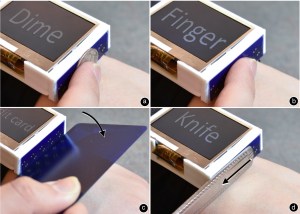 Abstract: We present Indutivo, a contact-based inductive sensing technique for contextual interactions. Our technique recognizes conductive objects (metallic primarily) that are commonly found in households and daily environments, as well as their individual movements when placed against the sensor. These movements include sliding, hinging, and rotation. We describe our sensing principle and how we designed the size, shape, and layout of our sensor coils to optimize sensitivity, sensing range, recognition and tracking accuracy. Through several studies, we also demonstrated the performance of our proposed sensing technique in environments with varying levels of noise and interference conditions. We conclude by presenting demo applications on a smartwatch, as well as insights and lessons we learned from our experience.
Read the full paper in ACM digital library:
Jun Gong, Xin Yang, Teddy Seyed, Josh Urban Davis, and Xing-Dong Yang. 2018. Indutivo: Contact-Based, Object-Driven Interactions with Inductive Sensing. In Proceedings of the 31st Annual ACM Symposium on User Interface Software and Technology (UIST ’18). ACM, pp.321-333. DOI: https://doi.org/10.1145/3242587.3242662
Watch the presentation:

 Auracle – wearable technology for the study of eating behavior